“The sample positioning is clear, structured and much easier to follow than a generic tarot guide.”
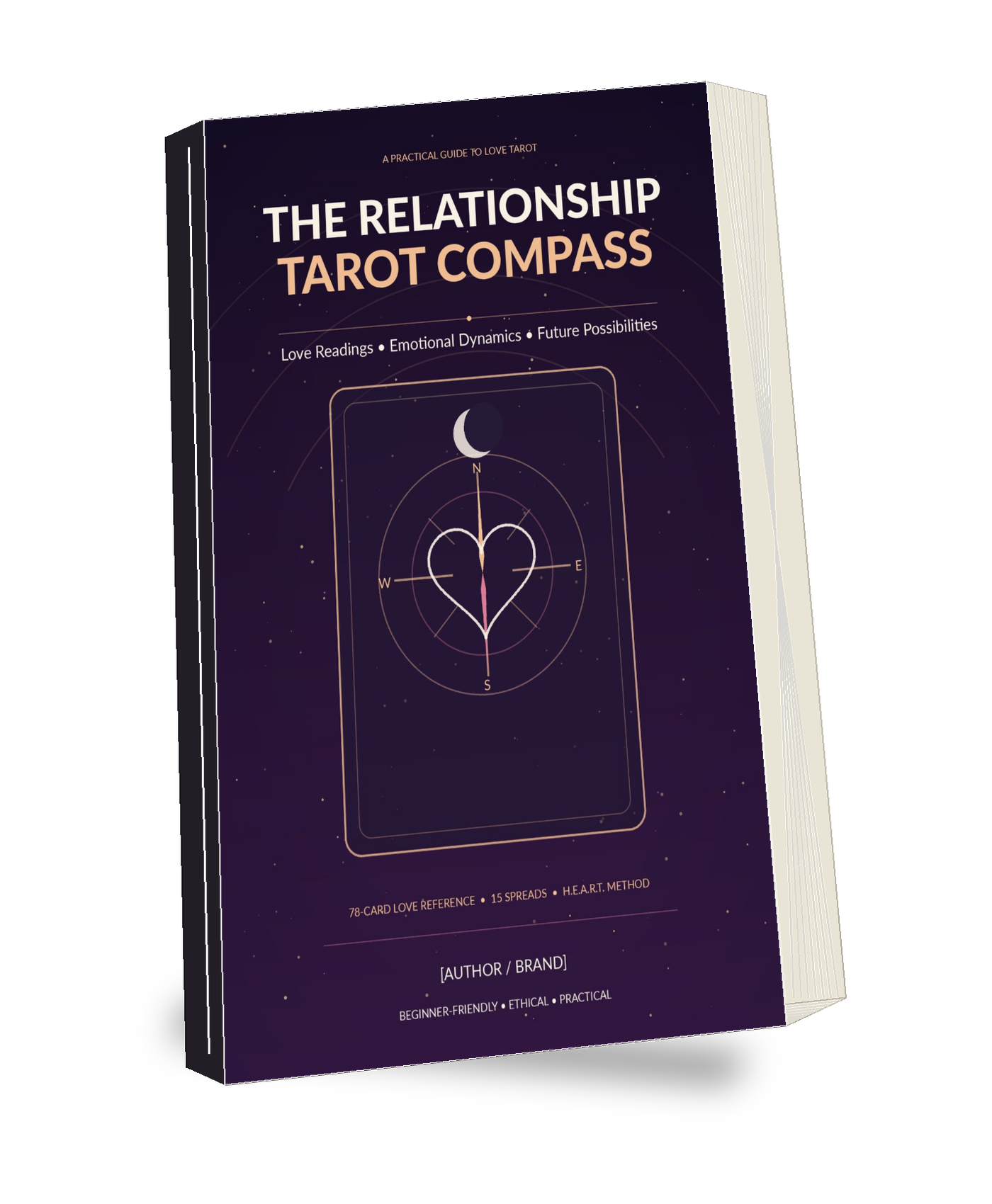
A practical guide to love readings, emotional dynamics and future possibilities — built around a repeatable reading process rather than disconnected tarot keywords.
Relationship questions can make tarot feel harder than it needs to be. You may know the card's traditional meaning — but still struggle to connect it to the actual question, spread position and relationship context.
The Compass teaches you to slow down, read the position, connect the cards, check the story against reality, and finish with an action the querent can actually control.
Reframe loaded or certainty-seeking questions into useful, open questions.
Interpret what the card means in that position, not in isolation.
Bring in suits, numbers, court cards, patterns and relationship dynamics.
Assemble the cards into one coherent relational narrative.
Translate insight into a healthy next step, boundary or conversation.
The operating system of the book: a repeatable process designed to help beginners build confidence and experienced readers avoid jumping from one dramatic card to a conclusion.
Use neutral language and hold the desired outcome lightly enough to interpret cards you did not hope to see.
Read the spread position first, then the card. Use traditional, relationship and position-specific meanings.
Look for dominant suits, repeated numbers, Major Arcana turning points and agreement or tension between positions.
Use language like “this suggests” and “one possibility.” Tarot is not a loophole around consent or observable reality.
Finish with something the querent can control: a question, conversation, boundary, pause, observation or next step.
The guide repeatedly separates symbolic possibilities from what can actually be observed in the relationship.
What emotional energy may be present.
Explore emotional themes without claiming mind-reading.What direction or behavior may be developing.
Interpret alongside context and observable behavior.What may develop under current conditions.
Conditions change when people make choices.What actual behavior and communication show.
Behavior, boundaries, consistency and values matter.The ebook's actual table of contents spans foundations, the H.E.A.R.T. method, all 78 cards, dedicated spreads, combinations, reversals, timing, practice, professional reading and a structured 30-day challenge.
Grounded, ethical foundations.
Core relationship reading principles.
Better questions create better readings.
A repeatable reading process.
Relationship-focused card reference.
A foundational relationship spread.
Seven-card structured exploration.
Future possibilities under current conditions.
Patterns, change, boundaries and wellbeing.
Green flags, cautions, compatibility and pace.
Communication, trust, values and practical life.
Build stories instead of isolated meanings.
Responsible timing language and uncertainty.
Structured approaches instead of simplistic counting.
Common traps and healthier alternatives.
Structure, clarity and ethics for readings for others.
Apply the system through examples.
Record, review and improve your interpretations.
Move from card literacy to full readings.
Professional direction without income promises.
Confidence through process and uncertainty.
Six practical bonus resources inside the ebook.
The Bonus Library contains 15 ready-to-use spread diagrams, while the main chapters teach the core relationship spreads in depth.
Their energy • Your energy • Relationship energy. A simple starting point for the current dynamic.
What I want to say • What I fear • What needs to be heard • Best approach.
What draws me in • What is real • Green flag • Caution • Compatibility • Pace • Next step.
Conscious feeling • Hidden emotion • Attraction • Fear • Intention • Obstacle • Next energy.
Current situation • Foundation • Approaches • Needs • Hidden issue • Challenge • Opportunity • Directions • Advice.
Cause • Lesson • Unresolved emotion • What must change • Support/caution • Wellbeing.
Communication • Emotions • Values • Lifestyle • Conflict style • Growth edge.
Commitment level • Support • Block • Discussion • Next realistic milestone.
Damage • What remains true • Accountability • Reassurance • Boundary • Repair.
What I defend • What they may defend • Core conflict • De-escalation • Repair.
Truth • Reasons/costs • What a pause reveals • Most self-respecting next step.
Green • Yellow • Red/caution • Verification • Staying grounded.
My need • Observable need • Shared need • Mismatch • Adjustment.
Bond • Communication • Distance challenge • Feasibility • Milestone • Advice.
What I hold • What I accept • What I learn • What I release • What opens next.
These previews are rendered directly from the supplied ebook PDF — not fabricated “fake screenshots.”
One card can be suggestive. A relationship reading becomes more useful when you understand how cards reinforce or challenge one another — and how their meaning changes with the position.
The reconciliation material focuses on patterns, unresolved emotion, what must change, accountability, boundaries and your wellbeing — including the possibility that moving forward may be healthier.
The book recommends a reading interval: do not repeat the same question until something in the real-world situation has materially changed.
A reconciliation reading should include a path that remains valuable even if reconciliation never occurs.
The supplied PDF includes a dedicated Bonus Library with resources designed to make the system easier to use and practice.
Prompts for new love, current relationships, crushes, commitment, exes, reconciliation, communication, compatibility, personal growth and future direction.
Ready-to-use spread diagrams including Relationship Energy, New Connection Compass, Reconciliation Reality Check, Compatibility Wheel and more.
Suit lenses, court lenses, responsible future-reading language, the H.E.A.R.T. Method and five reality checks.
A structured template for question, spread, cards, themes, caution, opportunity, conditional direction, next step and uncertainty.
Before, during and after checklists covering questions, emotional intensity, positions, combinations, boundaries and follow-up.
Realistic practice situations covering dating, communication, trust, reconciliation, long-term relationships, timing and professional reading.
The ebook is explicit about what tarot can and cannot responsibly tell you. That makes the framework more grounded — not less useful.
These are clearly marked sample review placeholders for design purposes. Replace them with genuine customer feedback before publishing.
| Generic Tarot Guide | The Relationship Tarot Compass |
|---|---|
| Generic card meanings | Relationship-specific interpretation |
| Random keywords | Structured H.E.A.R.T. process |
| Single-card thinking | Card + position + context |
| Prediction-only approach | Possibilities + reflection + action |
| Memorization | Repeatable reading process |
| Random spreads | Relationship-focused spreads |
| No practice path | 30-Day Relationship Tarot Challenge |
You don't need to memorize all 78 cards before you can start practicing useful readings.
Add a dedicated relationship lens to the tarot skills you already have.
Explore feelings, intentions, dynamics, dating, commitment, breakups and future possibilities more systematically.
Learn to structure readings for others with clearer language, boundaries and ethical practice.
Move away from loaded, certainty-seeking questions.
Use a practical reference whenever you need it.
Read cards in context instead of as isolated labels.
Separate feelings, intentions, potential and reality.
Use the journal and 30-day challenge to build process.
Structure readings around clarity, uncertainty and agency.
Instant-access digital product. No fake “limited stock” or invented crossed-out pricing.
GET INSTANT ACCESS →Yes. The ebook is explicitly positioned as beginner-friendly and says you do not need to memorize all 78 cards before performing a useful relationship reading.
Yes. Chapter 4 is a relationship-focused reference for all 78 tarot cards.
Yes. The ebook teaches dedicated relationship spreads and its Bonus Library contains 15 additional relationship tarot spread diagrams.
Yes. The reconciliation material focuses on patterns, possibilities, communication, change, accountability, boundaries and wellbeing rather than promising reunion.
Yes. The New Love & Dating chapter includes a New Connection Compass, green-flag themes, red-flag themes and a grounded approach to compatibility.
Yes. The long-term relationship material focuses on communication, trust, shared values, conflict repair, emotional intimacy, practical cooperation, commitment and individual growth.
Yes. These are dedicated topics in the book, with an emphasis on context and responsible uncertainty rather than simplistic rules.
Yes. It includes a chapter on conducting a professional relationship reading, a client template, a reading checklist, practice client scenarios and ethical side-business guidance.
Yes. Chapter 18 is a 30-Day Relationship Tarot Challenge with daily exercises designed to move from card literacy toward full readings.
No. The ebook explicitly says tarot cannot verify another person's private thoughts. It frames readings as symbolic possibilities to consider alongside observable behavior, communication, boundaries and consent.
No. The guide explicitly rejects guaranteed outcomes. Its approach is based on possibilities, current conditions, reflection and actions within your control.
Learn a structured relationship-tarot process that helps you ask better questions, connect cards in context, respect uncertainty, and finish with something useful you can actually do.
GET THE RELATIONSHIP TAROT COMPASS — ₹297 →